go-dataframe documentation
go-dataframe is labelled, columnar tables in pure Go. Series,
DataFrame and Index, with selection, missing data, group-by, joins,
reshaping, time series, a fast CSV reader, Arrow IPC and Parquet, notebook
display and plots. Numeric columns are
go-ndarray arrays, handed out
without copying.
pandas is the behavioural reference: the operations give pandas’ answers (values, dtypes, index, row order), checked against pandas 3.0 on 173 recorded cases; the differences that remain are deliberate and listed in Design.
package main

import (
	"github.com/go-dataframe/dataframe"
	"github.com/go-dataframe/dataframe/dfplot"
	"github.com/go-plot/plot"
)

func init() { register("bars", bars) }

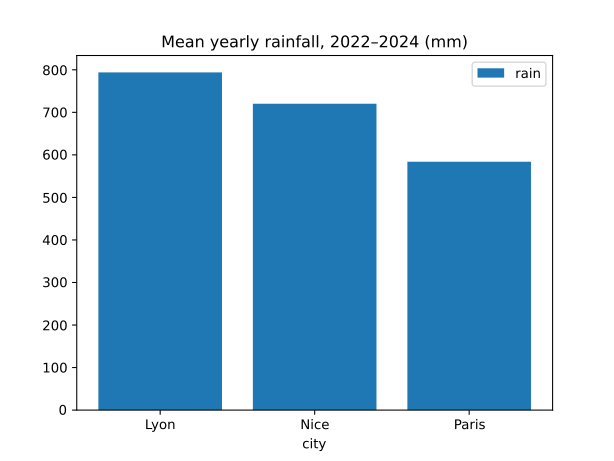
// df.groupby("city")[["rain"]].mean().plot.bar()
func bars() *plot.Figure {
	g := dataframe.Must(rainfall().GroupBy("city"))
	means := dataframe.Must(g.Mean())
	fig, err := dfplot.BarOpts(means, []string{"rain"}, []dfplot.Option{dfplot.WithTitle("Mean yearly rainfall, 2022–2024 (mm)")})
	if err != nil {
		panic(err)
	}
	return fig
}
These pages describe go-dataframe/dataframe v0.1.0. Every table printed and every figure in them was produced by that version, from the code shown beside it.
Install
go get github.com/go-dataframe/dataframe@v0.1.0The module needs Go 1.27.2 or later. It is pure Go (CGO_ENABLED=0).
import "github.com/go-dataframe/dataframe"

df := dataframe.Must(dataframe.ReadCSVFile("weather.csv", dataframe.CSVParseDates("date")))
fmt.Println(df.Head(5))
The pages
| Page | What it says |
|---|---|
| The API, call by call | every operation beside the pandas call it answers to |
| Notebook display | what a frame prints and the HTML table a notebook shows, produced by v0.1.0 |
| Plots | dfplot: a frame’s columns drawn with go-plot |
| Design | columns, the index, the algorithms, CSV, Arrow and Parquet, and the deliberate differences from pandas |
| Performance | time and memory against pandas 3.0 and polars, and how they were measured |
Speed, honestly
Medians of interleaved runs on 10⁷ rows (Apple M4 Max, a shared host under load; the performance page has the method, a second run under heavier load, 10⁶ rows, and Arrow/Parquet). Milliseconds:
| operation | go-dataframe | pandas 3.0 | polars |
|---|---|---|---|
read_csv (5 mixed columns) | 407 | 4220 (C parser) / 525 (pyarrow) | 360 |
read_csv, dates parsed | 362 | 5900 | 417 |
sort_values (stable, float key) | 446 | 973 | 298 |
merge (inner, int key) | 161 | 234 | 55 |
groupby("int key").sum() | 88 | 103 | 69 |
df[df.x > 0.5] | 74 | 75 | 20 |
groupby("str key").sum() | 222 | 204 | 60 |
go-dataframe is faster than pandas on all of these but the string-key
group-by, which is at parity (CSV by about 10x, sorting by 2x); polars
remains faster on most of them. Memory is at par with pandas for numeric
columns but worse for strings (a Go []string costs 16 bytes a value; pandas
3 and polars use Arrow-style string buffers): the benchmark table takes 400 MB
here, 349 MB in pandas, 269 MB in polars.
Packages
| Package | What |
|---|---|
dataframe | the core: Series, DataFrame, Index, CSV, display |
dataframe/arrowio | Arrow IPC (file/Feather and stream) and Arrow record conversion, over apache/arrow-go |
dataframe/parquetio | Parquet, over apache/arrow-go |
dataframe/dfplot | plots with go-plot |
Verification
testdata/gen_fixtures.pyrecords pandas’ answers (values, dtypes, index, NA handling, sort stability, group-by order, merge row order,reprtext) for 173 cases;TestPandasFixturesreplays them.- A corpus of 47 awkward CSV files (69 option sets) is compared with pandas' parse, and Arrow and Parquet files written by pandas/pyarrow are read back and compared.
- 100% statement coverage of the whole module under the race detector, on Linux, macOS and Windows; tests also run natively on amd64/arm64 and under qemu on riscv64, loong64, ppc64le and s390x (big-endian).
Built on
go-ndarray (numeric columns),
go-plot (dfplot) and
apache/arrow-go (Arrow and Parquet).
A go-notebook cell shows a frame
through Display.
Created on by tannevaled
Modified on by tannevaled